


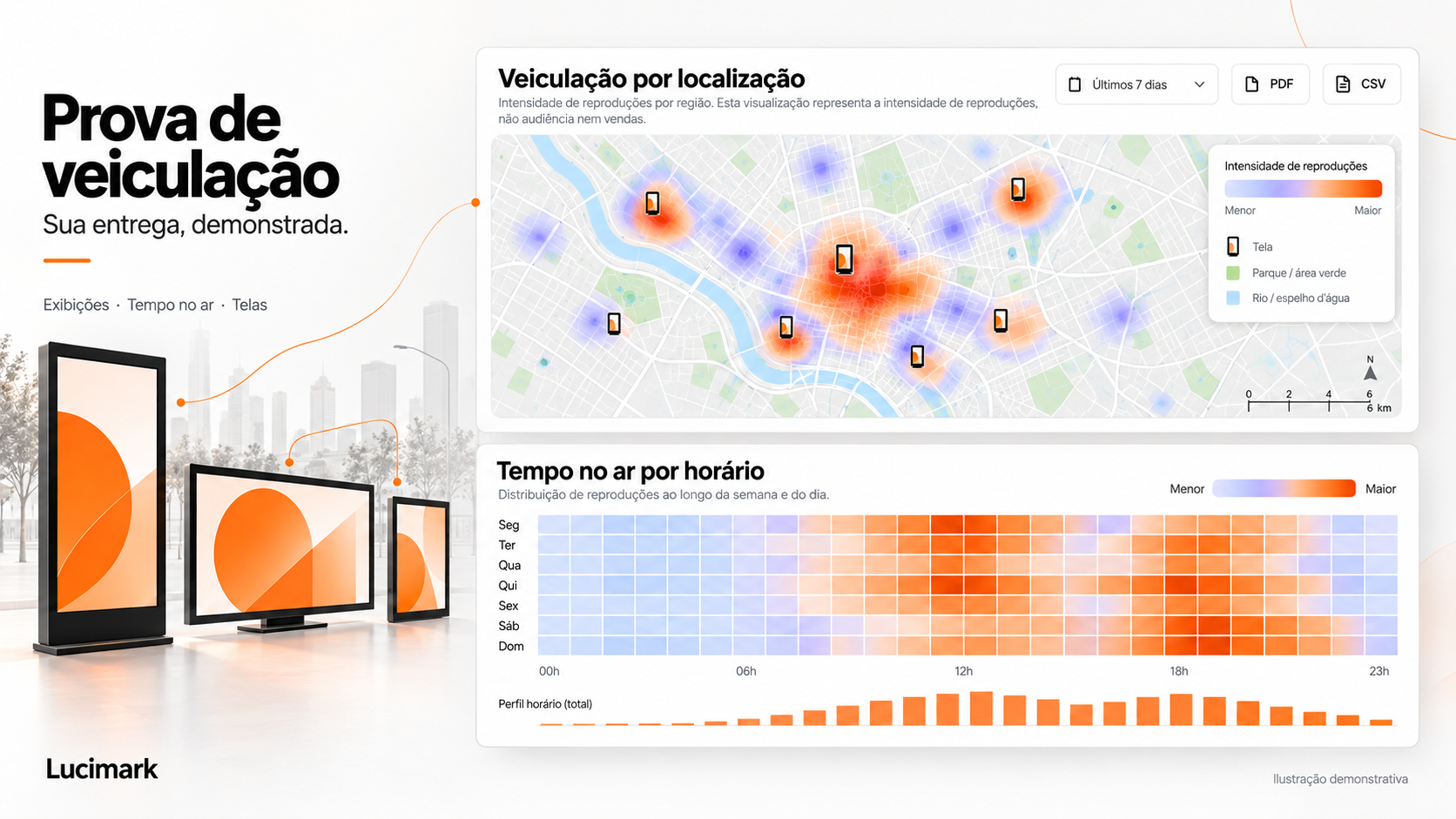
Selling ads on a digital signage network takes strong venues, a solid offer, and the ability to deliver what you promised. There is another part of the work that weighs heavily on the advertiser relationship: showing what happened after the campaign went live.
When a client asks where their ads played, how many times they ran, and for how long, the answer needs to be ready. That is when proof of play becomes part of your service — and an argument for presenting your network with more confidence.
Lucimark connects advertiser-linked media organization to playout records and delivery reports. For the network operator, that means a concrete base to follow campaigns, account for delivery, and talk about renewal.
From scheduling to recorded delivery
Proof of play is the record that a piece of content was played by the player — the system that runs the screen’s schedule. In Lucimark, those data points let you follow playouts, airtime, and the screens involved.
When you relate those records to an advertiser, you can look up that client’s delivery for a defined period. The question “did my ad play?” gets an answer you can put in a report.
That option already has value in the negotiation. When you show your network venues and explain the schedule, you can also agree how the advertiser will receive campaign information. Accountability becomes part of the offer from the start.
Every advertiser with their media organized
Picture a gym-network operator serving a supplement store, a physiotherapy clinic, and a nearby restaurant. Each client sends different creatives, distributed across the schedule of several venues.
In Lucimark, you can register advertisers and link them directly to media — one by one or in bulk from the gallery. That organization lets you gather playouts for each client’s ads, even when they have several files in circulation.
The flow fits direct sales: you negotiate with the advertiser and organize the content in Lucimark Studio. Linking by media lets you follow delivery per client without creating an order in Lucimark Book.
As the book of business grows, you keep a consistent way to organize ads and prepare accountability.
Know what to show the client
In reports, select the advertiser and the period to look up their playouts. You can refine the analysis by media, screen, and other filters, depending on the question you need to answer.
For the supplement store, for example, the report can show how many times their ads played, total airtime, and which screens showed them. Charts help explain how that delivery spread across days and hours.
Those insights are also useful during the campaign. If a creative got fewer playouts than you expected, or delivery clustered on certain venues, you have data to check the schedule and investigate the gap.
Comparison with the previous period adds to that reading. You can also set a playout goal and track delivery against it, based on what you negotiated with the advertiser.
Take the delivery history into renewal
At the end of the period, you can export a PDF report with metrics, tables, and charts. The data is also available as CSV for spreadsheets and extra analysis.
That makes it easier to build a service routine: agree on report cadence, present delivery, and discuss next steps with each client.
At renewal, that history helps lead the conversation. You can review which media ran, show how the campaign was distributed, and discuss adjustments for the next period. If something diverges from what was agreed, the records give you a starting point to investigate and find a solution.
Showing delivery is a way to sustain the relationship after the sale.
Trust also depends on clear metrics
To present results with confidence, explain what each number means. In Lucimark, the playout count reflects presentations that started, while airtime records the duration presented by the player. Read both measures together.
Proof of play is also different from audience measurement: it records that the content ran, but it does not by itself prove how many people looked at the screen or bought after seeing the ad.
That clarity helps set expectations and build a commercial offer on metrics your operation can stand behind.
Get your network ready for the next sale
Venue quality and commercial work still matter for revenue. The ability to organize campaigns and demonstrate delivery strengthens that structure.
With Lucimark, you gather each advertiser’s media, follow playout records, and prepare reports to present to the client. That process can be part of your operation from the first local campaign and scale with your book of business.
In the next negotiation, beyond showing where the ad will play, also show how the client will be able to verify delivery.
Proof of play and reports depend on the feature being enabled and on account permissions.